> For the complete documentation index, see [llms.txt](https://docs.viesus.com/llms.txt). Markdown versions of documentation pages are available by appending `.md` to page URLs; this page is available as [Markdown](https://docs.viesus.com/tools/viesus-viewer.md).
# VIESUS Viewer
The VIESUS Viewer is a Windows desktop application for visually tuning enhancement settings and testing configurations.
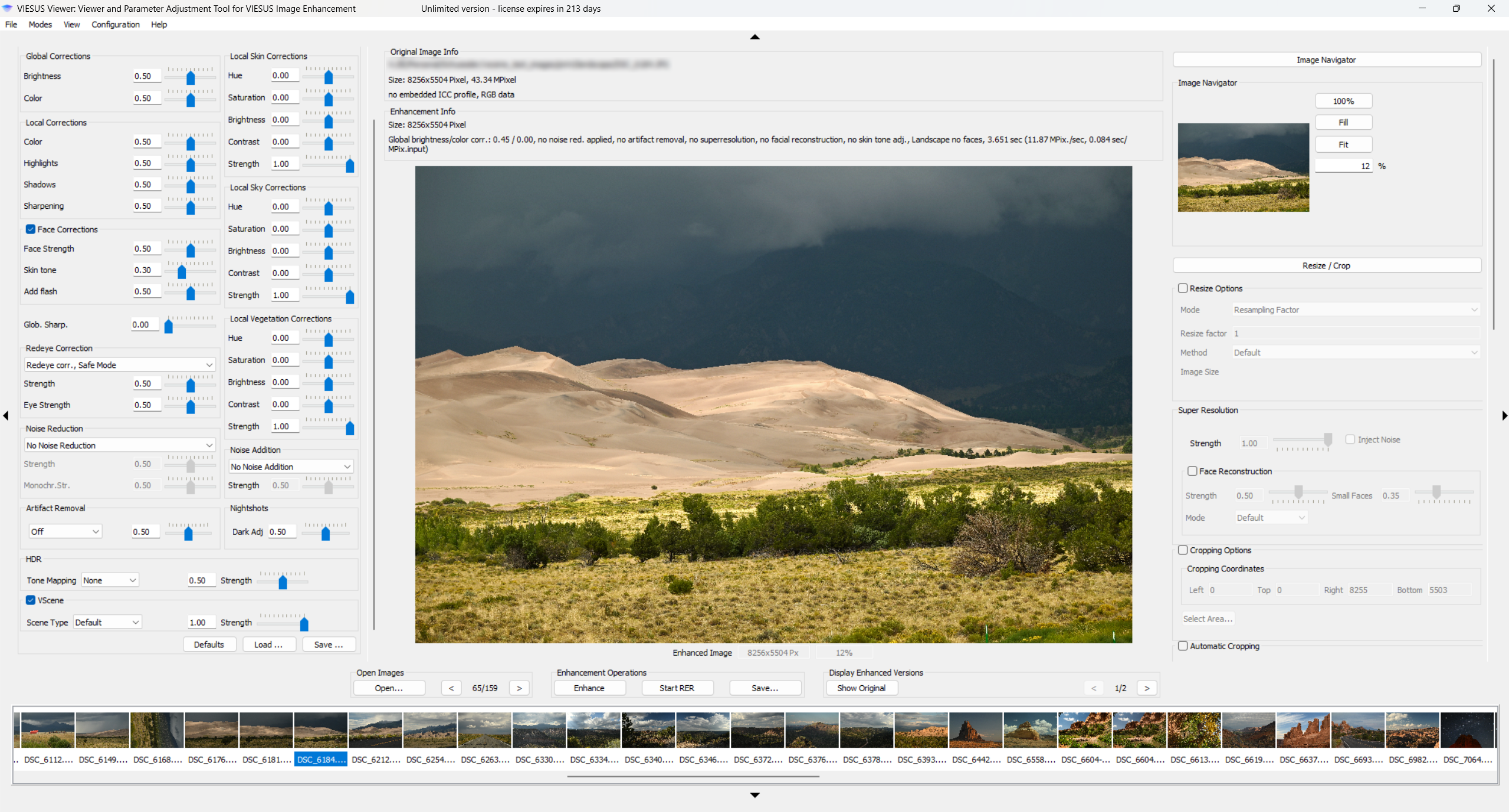
The VIESUS Viewer is a Windows desktop application that runs the same enhancement engine as the CLI and any other module. It provides a visual before/after interface so you can tune `viesusini.json` parameters and immediately see the effect on real images — without writing any code or running command-line tools.
***
## What the Viewer is for
| Task | Use the Viewer |
| -------------------------------------------------- | --------------------------------------- |
| Visually compare before and after enhancement | Yes |
| Tune parameters and see live results | Yes |
| Export a tuned `viesusini.json` for production use | Yes |
| Batch processing in production | Limited — use the CLI or Node.js module |
The Viewer is not designed for production throughput. Use it to develop and validate your `viesusini.json` configuration, then use that same file with the CLI or Node.js module.
***
## Installing the Viewer
The Viewer is included in the Windows installer package, see [CLI & Viewer](/installation/cli.md).
***
## Using the Viewer
### Loading an image
{% stepper %}
{% step %}
Open the Viewer
{% endstep %}
{% step %}
**File → Open** or drag an image file onto the window
{% endstep %}
{% step %}
The unenhanced image appears in the left panel
{% endstep %}
{% endstepper %}
### Applying enhancement
{% stepper %}
{% step %}
Open your `viesusini.json` via **File → Open Settings** (or create a new one)
{% endstep %}
{% step %}
Click **Enhance** to process the image with the current settings
{% endstep %}
{% step %}
The enhanced result appears in the right panel
{% endstep %}
{% step %}
Use the slider or toggle to compare before and after
{% endstep %}
{% endstepper %}
### Tuning parameters
Adjust parameters in the settings panel on the right side of the window:
* Changes take effect on the next **Enhance** click
* The underlying `viesusini.json` is updated as you adjust sliders
* Save the updated configuration with **File → Save Settings**
### Exporting configuration for production
After tuning in the Viewer, the saved `viesusini.json` file can be used directly with the CLI:
```bash
viesus -p /path/to/viesusini.json -l images.lst -s
```
GUID-licensed deployments add `-g "$GUID"` to the command.
Or with the Node.js module:
```js
viesusObj.Enhance(fromPath, toPath, '/path/to/viesusini.json', resPath);
```
The Viewer, CLI, and Node.js module all read the same file format and produce identical output for the same input and settings.
---
# Agent Instructions
This documentation is published with GitBook. GitBook is the documentation platform designed so that both humans and AI agents can read, navigate, and reason over technical content effectively. Learn more at gitbook.com.
## Querying This Documentation
If you need additional information that is not directly available in this page, you can query the documentation by asking a question.
Perform an HTTP GET request on the following URL with the `ask` and `goal` query parameters:
```
GET https://docs.viesus.com/tools/viesus-viewer.md?ask=&goal=
```
`ask` is the immediate question: it should be specific, self-contained, and written in natural language.
`goal` is what the user is ultimately trying to achieve, the reason they need the answer. Sharing it helps GitBook give you a better, more relevant answer. A goal is most helpful when it describes the outcome the user wants rather than restating the question. For example, with `ask=how do I create an API token`, a goal like `automate deployments from our CI pipeline` lets GitBook tailor the answer to that use case.
The response will contain a direct answer to the question and relevant excerpts and sources from the documentation.
Use this mechanism when the answer is not explicitly present in the current page, you need clarification or additional context, or you want to retrieve related documentation sections.